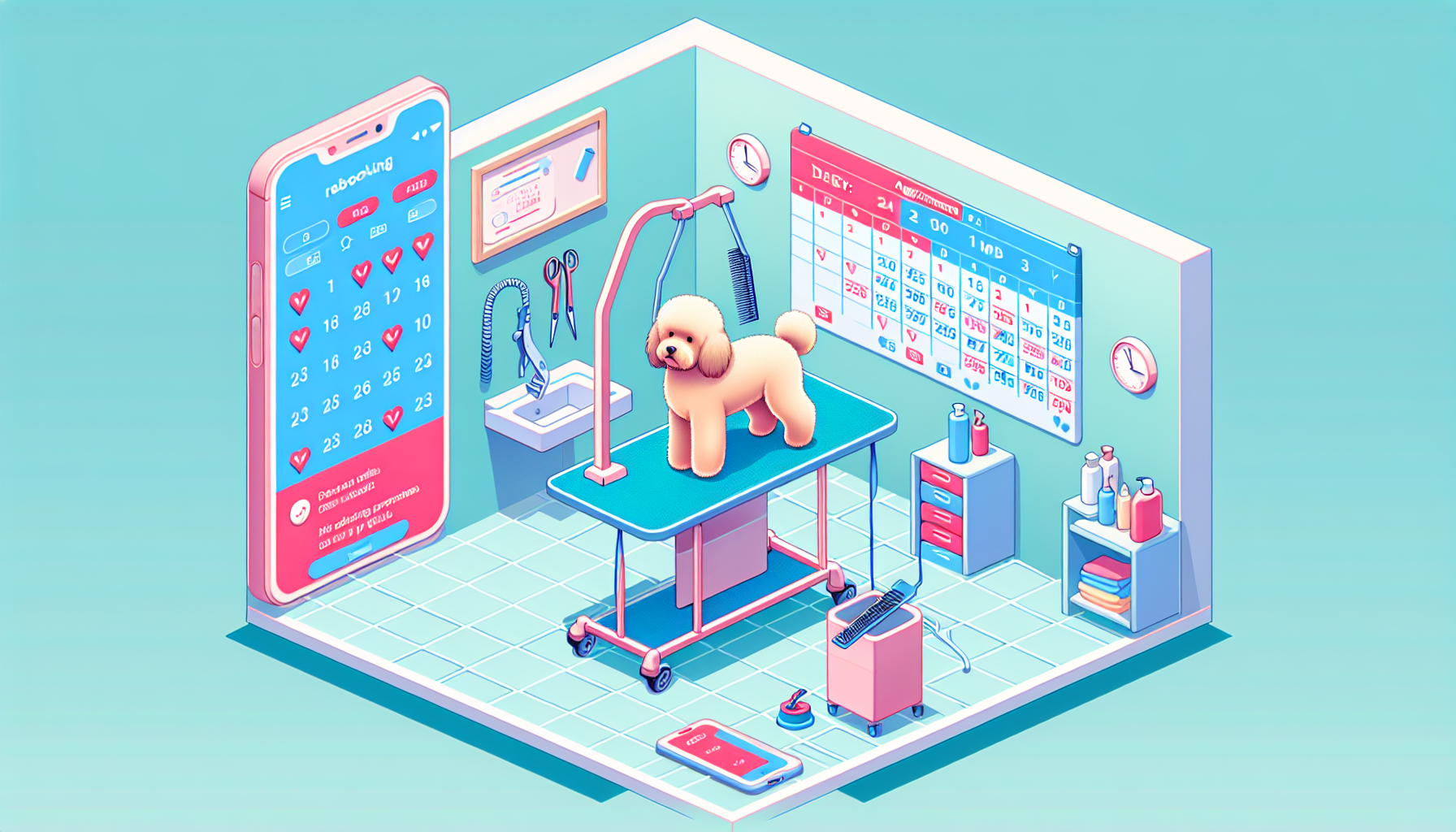
Dog grooming is an inherently recurring service — most dogs need it every 6-8 weeks. But most grooming salons wait for the phone to ring. The salons with packed schedules and loyal regulars aren't busier. They're just better at the window right after the appointment. I mapped what the difference actually is, and how a couple of automated messages change the math.
There are two types of dog grooming salons. The first type has a two-week waitlist, a loyal base of regulars who rebook immediately, and a word-of-mouth pipeline that fills openings before they're even posted. The second type is constantly running specials to attract new clients, wondering why so many first-timers never return, and feeling like the business is always starting over.
The grooming quality is often identical. The difference is almost entirely in what happens in the first 8 weeks after a new client's first appointment.
I mapped the rebooking behavior of grooming clients across different salon types, and the pattern is consistent: groomers who systematically reach out at the 5-week mark after each appointment have regular clients. Groomers who wait for the phone to ring have a high churn rate masked by the constant arrival of new clients. They're running in place.
Most recurring service businesses have a natural scheduling cadence that creates some built-in retention. A landscaping client is on a weekly mow schedule. A cleaning client has a standing biweekly appointment. The job appears on the calendar and then happens — the client doesn't have to decide to rebook each time.
Dog grooming is different. The dog needs grooming every 6-8 weeks, but there's no standing appointment. Every booking is a fresh decision by the client. The dog's hair grows back whether the client thinks about grooming or not, and by the time it becomes visually obvious (or the dog is uncomfortable), they might Google the nearest groomer and try someone new — not because they disliked the original experience, but because they weren't thinking about it, and the closest option won.
This means every single appointment has a 5-6 week window in which the client should be rebooking — and if nothing prompts them to do so, a meaningful percentage of them will drift to someone else.
The retention math in grooming is heavily front-loaded. A client who books three times in a row becomes a regular. A client who books once and doesn't rebook within 10 weeks has a 60-70% chance of never coming back — not because the experience was bad, but because the habit never formed.
The critical window is after appointments one and two. After appointment one, the client is evaluating: was the dog happy? Did the cut look right? Was the experience worth the price and the trip? Most first appointments that go well would naturally lead to a second — except that 6 weeks pass, the groomer doesn't reach out, and the client ends up booking somewhere else out of convenience.
After appointment two, a client who rebooks is beginning to form a habit. After appointment three, they have a regular groomer. The groomer who captures appointments one and two reliably — with a prompt rebooking message at week 5 — captures the regular client. The groomer who waits loses them, and never knows why.
My initial approach to a grooming rebooking workflow was to trigger the outreach at the 7-week mark — right at the edge of the typical 6-8 week grooming window. Seemed logical: reach out when they're right at the point of needing a groom.
The problem: at 7 weeks, some clients have already booked. Not necessarily with another groomer — some book the week after their appointment because they like having it locked in. Those clients get the rebooking message and feel like the groomer didn't notice they'd already scheduled. Minor annoyance, but not a good look.
More importantly: clients who would drift to a competitor often make that decision at weeks 5-6. Waiting until week 7 to send the message is arriving after the decision window has partially closed. Competitors who run "book your next appointment before you leave" prompts at checkout are capturing those clients in the chair.
The fix was moving the trigger to 5 weeks — right before the rebooking window opens naturally, and well before the drift decision gets made. At 5 weeks, the dog's coat is showing early growth and the client is starting to notice. That's the moment to reach out: "It's been about 5 weeks since [dog name]'s last groom — we're starting to book out for next week and wanted to give you first pick before the slots fill." That framing is honest and captures clients at exactly the right moment.
The workflow has two parts: rebooking sequence and special occasion layer.
Rebooking sequence: Every completed appointment triggers a timer. At week 5, a text goes out from the salon's number: "Hey [client name] — it's been about 5 weeks since [dog name] was in for their [service]. We're booking out for next week — want me to hold a spot? We have [day] and [day] available." If the client responds, the conversation routes to the front desk for booking. If there's no response by day 3, a gentle follow-up fires: "Just checking — still have [day] at [time] open for [dog name]. Let me know!" If still no response after day 7, the sequence ends. No third message. Three weeks of silence after a second outreach means the client is either handled or gone for now.
The messages go out via SMS from the salon's number — or from a dedicated number that feels personal, not from a marketing platform. The dog's name and the specific service are included because that detail signals that someone is paying attention. "It's been 5 weeks since Waffles was in for his full groom" is a message that could only have been sent to this client. Generic "time for your pet's grooming appointment" feels like a newsletter.
Special occasion layer: Dog birthdays are a genuinely underused retention tool. When a client adds their dog's birthdate at intake (which most grooming software captures), an annual birthday message fires: "Waffles' birthday is coming up! We offer a birthday groom package — bandana, birthday photo, and a treat — if you want to make it special. Here's a link to book." Birthday rebooking rates in salons that run this message are 30-40% higher than standard rebooking prompts. People genuinely like celebrating their dog's birthday, and a groomer who remembered it without being asked builds the kind of loyalty that a price comparison can't break.
The highest-risk moment in grooming client retention is right after the first appointment, and it requires a specific approach.
A first-time client who had a good experience needs two things in the 24-48 hours after their appointment: confirmation that the experience was positive and a clear path to rebooking. The post-appointment message handles both: "So glad to have Waffles in today — [groomer name] did a great job with his coat. We'd love to have him as a regular. He's due for his next groom in about 6 weeks — want me to pencil him in now while we have good availability?" This message does something subtle: it suggests the client is already a "regular," which makes the second booking feel like the natural next step rather than a new decision.
First-time clients who receive this message and rebook rebook at a materially higher rate than clients who don't. The rebooking suggestion immediately after the first appointment, while the experience is fresh, captures a large portion of potential regulars who would otherwise drift.
Most grooming reminder messages are generic. The groomers who stand out do something anyone with scheduling data can do: reference the dog's specific coat needs in the outreach.
A poodle mix needs grooming more frequently than a short-coated breed. A double-coated dog in shedding season needs a different service than the same dog in winter. A groomer who sends "Hey — Biscuit is a Goldendoodle so her coat really does better on a 6-week schedule; she'll start matting beyond 8 weeks" is demonstrating expertise that a generic reminder can't replicate.
This information is in the intake form. The groomer knows the breed. The service record shows the history. The message can include one specific sentence that signals knowledge of this particular dog — and that specificity is worth more than any discount in converting a first-timer to a regular.
A lot of groomers reading this will say: I already try to rebook at checkout. Why do I need an automated message?
The checkout rebook works — for clients who have 5 minutes to think about their schedule at pickup. For clients who are in a hurry, distracted by the dog, or just not in decision mode at that moment, the checkout prompt gets a "I'll call you" and is immediately forgotten. And on busy Saturdays when the groomer is managing six dogs and three pickups simultaneously, the rebook prompt often doesn't happen at all.
The automated message is the backup for the checkout prompt that didn't land. It goes out regardless of what happened at pickup, without requiring anyone to remember to send it. The 5-week timing means it catches clients who were genuinely intending to call and hadn't gotten around to it — which is most of them.
Grooming software ranges from modern platforms like MoeGo and 123Pet with API access, to simpler scheduling tools, to salons still running on a paper appointment book. The integration path varies by where the client data lives.
For MoeGo users, OpenClaw can pull completed appointment data in near real time and trigger the sequence automatically. For salons on simpler systems, a weekly export or manual date entry ("[dog name], [client phone], [appointment date], [service]") kicks off the sequence. The manual version takes 30 seconds per appointment. For a salon doing 20-30 grooms per week, that's under 15 minutes — which is worth it if the rebooking rate improves meaningfully.
Twilio SMS for a 30-groom-per-week salon, running the 5-week and 8-week sequence on every appointment, costs roughly $15-20 per month. The birthday message layer adds another few dollars annually per active client. Total: under $25/month for a robust retention system.
Dog groomers with packed schedules and loyal regulars didn't get there by doing better grooming than their competitors. They got there by being in the client's phone at exactly the right moment — before the 8-week window closed, before the client Googled the nearest alternative, before the habit drifted somewhere else.
The 5-week rebooking message is the single highest-impact communication in the entire client relationship. It costs almost nothing to send. It requires the groomer to record one thing accurately: the appointment date and the client's phone number. Everything else is automated.
For a grooming salon doing 30 appointments a week, improving rebooking rates by 20 percentage points means 6 additional recurring appointments per week — booked without any new marketing, from clients who already chose the salon once and liked it. That's the whole business model, running on autopilot.
If you run a grooming salon and already have a rebooking system — I'm curious what your actual rebooking rate looks like. My rough benchmark: 40-50% for salons that don't proactively reach out, 65-75% for ones that do. Drop a comment if your numbers are significantly different. Especially curious about first-appointment-to-second conversion, which I think is the most actionable metric in this business.